
Art Lesson for The Family School

Pieter Bruegel the Elder, Pleasant Peasants
Children will learn about the life and art of Pieter Bruegel, including the use of peasants, landscapes, and bright colors in his paintings. Children will learn that each person is a divine son or daughter of our Heavenly Father.
Academic Concept: Pieter Bruegel the Elder was a painter from the Netherlands. He was known as “Peasant Bruegel” because of his famous peasant paintings.
Gospel Principle: Each person is a divine son or daughter of our Heavenly Father.
New Vocabulary
genre painting—art that depicts everyday life, portraying ordinary people engaged in common activities.
landscape painting—natural scenery such as mountains, valleys, trees, rivers, and forests, usually using a wide view
LESSON
Attention Activity
} Show (1) Detail from Children’s Games. This painting is a small detail or section from a larger painting called Children’s Games. The artist is Pieter Bruegel. Children of all ages and all over the world like to play games.

- What game are the children playing in this picture? (They are playing leap frog!)
Let’s play leap frog too! To play leap frog, at least two or more players line up with space between each person. Each player in the line kneels down and covers their head with their hands. Then one player leaps over each player in the line like a frog. Let’s watch this video to see how it’s played. } Watch (2) Video of How to Play Leap Frog (1:01).
Even children 400 years ago played games just like you. } Show (3) Children’s Games (1560). We are now seeing the complete painting called Children’s Games.

- What kinds of games can you see children playing in this painting? (Accept any answer.)
If you look carefully there are at least 80 different kinds of games being played. } Show the children a visual list of the games portrayed in this painting using (4) Children’s Games Description.
Today we are going to learn more about the artist who created this fun painting.
Lesson
The artist who painted, Children’s Games, is Pieter Bruegel (pronounced BROYgul) the Elder. He was born in the Netherlands in a border town between Holland and Belgium around 1525.
- Can you find the Netherlands on our map? } Show the children Netherlands on a map or globe or show (5) Map of Netherlands in Europe.

In future lessons we will study other artists from this area of Europe. Because there were so many excellent artists in the Netherlands in the 1500-1600s, this period of time is called the Dutch Golden Age of art. Bruegel was one of the great Dutch artists from just before the Golden Age. Pieter Bruegel had two sons, Jan and Pieter, who also became artists. The Pieter Bruegel of our lesson today was Pieter Bruegel the Elder. His last name was originally spelled Brueghel, with an “h,” but because there were a lot of artists in his family, he changed the spelling so people would know that he was the “Elder artist Bruegel” without the ‘h’!
Not a lot is known about Bruegel’s early years or about his art education. We do know that it was an exciting time to live in the Netherlands. The people living in neighboring villages peacefully traded with one another. People came from all over to do business in this area. It become a place where good ideas were shared and spread—especially ideas about art. Bruegel collected ideas and techniques from a variety of artists until he developed his own unique style. As you will see in a minute, his paintings were very different from the other paintings of other artists we have seen this year.
Bruegel’s most pleasant pieces of art were his genre paintings of peasants, like Children’s Games. Genre art is art that depicts everyday life and ordinary people engaged in common activities. Bruegel was not a peasant, but he was fascinated by the peasant way of life and would dress up as a peasant so he could go among them and get ideas for his art. His wealthy friends thought this was hilarious. This is how he got the nickname “Peasant Bruegel.”
Let’s look at two of his genre paintings of peasants. } Show (6) The Hay Harvest (1565). This painting is called The Hay Harvest. } Allow the children time to describe what they notice.

} Show (7) The Peasant Wedding (1568). This painting is called The Peasant Wedding. } Allow the children time to describe what they notice.

Just as in his painting called, Children’s Games, these paintings shows a lot of action—a lot of people doing a lot of different things. Notice that he unifies all this chaos with the use of the same bright colors repeated throughout the painting.
- What colors does he repeat throughout the painting in Children’s Games? (Turquoise, red, gold.)
- What colors do you see spotted throughout the painting, The Peasant Wedding? (Red, gold, green, white.)
At an early point in Bruegel’s life he went on a trip to visit other parts of Europe, including Italy. His home in the Netherlands was near the sea, and the land was very flat. When he saw the grandeur of the Alps mountain range and the beauty of valleys covered in snow, he was in awe! He loved painting snowy landscapes and creating intricate engravings of the Alps. He never forgot those mountains and when he returned to live in Brussels he continued to paint grand landscapes with snowy mountains and included his peasants in them as well.
As we look at the next two landscapes notice the way he painted his trees in the foreground with mountains in the distance. } Show (8) Hunters in the Snow (1565) This painting is called Hunters in the Snow. } Allow the children time to describe what they notice.
_-_Google_Art_Project.jpg)
} Show (9) Winter Landscape with Skaters and a Bird Trap (1565). This painting is called Winter Landscape with Skaters and a Bird Trap. } Allow the children time to describe what they notice.

Let’s look at one more type of art by Pieter Bruegel. I want to show you his religious paintings. Sometimes Bruegel used his unique style with grand landscapes, bright colors, and peasants, to portray scripture stories.
_-_Google_Art_Project_-_edited.jpg)
} Allow the children time to describe what they notice.
} Show (11) The Numbering at Bethlehem (1566). This is his painting of Mary and Joseph traveling to Bethlehem to be taxed. } Allow the children time to describe what they notice.

- Do these religious paintings seem different than the religious paintings of other artists we have studied? (Yes.) In what way are they different? (They are more playful, more fun, almost cartoonish.)
Notice that these paintings are more complicated and detailed, with groups of simple people spread over the canvas. Notice that the people are dressed like the people who live during Bruegel’s time in history, not in the way people dressed at the time of the Tower of Babel or at the time of Jesus birth. They are not historically accurate.
- Why do you think he painted the people in his religious paintings to look like the ordinary peasants of his day? (Perhaps he hoped it would help the common people place themselves in the story and appreciate the message of the story.)
- What do you think of Pieter Bruegel’s work? Do you like the action? The colors? The landscapes? (Accept any answer.)
Today we have learned that, “Pieter Bruegel the Elder was a painter from the Netherlands. He was known as “Peasant Bruegel” because of his famous peasant paintings.” Write this academic concept on the board.
Gospel Connection
Gospel Principle: Each son is a divine son or daughter of our Heavenly Father.
During Pieter Bruegel’s time it was common for rich people and governments leaders to pay artists to paint their portraits. But Bruegel painted everyday common people. In paintings where there were rich and poor people he showed them as equals—interacting with nature and experiencing the same joys and problems of life.
Throughout history rich, powerful, or famous people have been treated differently than common people. Listen as I read two sentences from The Family: A Proclamation to the World.
All human beings—male and female—are created in the image of God. Each is a beloved spirit son or daughter of heavenly parents, and, as such, each has a divine nature and destiny.
- Do you think rich, powerful or famous people are more important that common people? (No. We are all created in the image of God, we are all His children and we all have divine nature and destiny.)
- What do we learn about all people from the following verse in the Book of Mormon? In 2 Nephi 26:33 it says: “and he [God] inviteth them all to come unto him and partake of his goodness; and he denieth none that come unto him, black and white, bond and free, male and female; and he remembereth the heathen; and all are alike unto God, both Jew and Gentile.” (We learn that the Lord wants all of us to come unto him and be blessed. He does not turn anyone away. He loves all people equally. We are all alike to Him.)
When Christ was on the Earth He spent time with all kinds of people. He helped people who were rich or poor, young or old and it did not matter what race the people were. He invited all people to come unto him.
- Do you believe that God loves all people? (Accept any answer.)
- Do you think it is important for us to treat people the way Jesus treated people? (Yes.)
- What is one thing we could each do to be more like Jesus and treat all people the way Jesus would? (We can show kindness to people no matter what they look like, what color their skin is, where they are from, or how much money they have.)
Pieter Bruegel’s wonderful paintings of common peasants can remind us to show love to all people because, “Each person is a divine son or daughter of our Heavenly Father.” Write this gospel principle on the board.
ART PROJECTS
Art Supplies
Littles/Middles: Watercolor paper, painting paper or canvas board, acrylic paints (especially white), paint brushes, paint shirt
Bigs: Canvas or canvas board, acrylic paints (especially white), paint brushes, paint shirt
Littles/Middles Activity: Pieter Bruegel Landscape
- Today we will paint a simple landscape and we will understand that objects in the distance in a painting are a lighter color than the objects closest to you. This is called atmospheric landscapes and Pieter Bruegel was very good at this technique.
- Let’s look at an example of what your landscape is going to look like. } Show (14) Bruegel Landscape Examples
- On a piece of watercolor paper, acrylic paper or canvas, draw three rounded hills on top of each other. First, draw a rounded hill from the left side of the paper to the right side. The hill should cover the bottom ⅓ to ¼ of the paper. This is hill #1.
- Draw another hill on top of hill #2. This hill is drawn with a diagonal line from the top of hill #1 to the side of the paper. This hill should be higher than hill #1.
- Draw a third hill higher than hill #2. Again, draw a diagonal line from the top of hill #2 to the side of the paper. Hill #3 should be above hill #2 and can reach the top edge of the paper. Now you have a simple landscape with hill #1 closer to you visually; hill #2 is in the middle and hill #3 is in the background.
- Next, you will paint the hills from dark to light. Choose one color of paint, like green, blue or orange, and paint hill #1 the bright color.
- Mix your bright color with white to make a lighter tint. Paint hill #2 the lighter color. Tip: When mixing paint, do not press hard on your paint brush because this will ruin the brush, so mix softly and gently until you get the color you desire.
- Finally, mix more white paint into your lighter shade for an even lighter color than hill #2. Paint hill #3 the lightest color you mixed.
- Clean your brush with water and use white paint to paint the sky. This will look just like the white winter skies of Bruegel’s landscapes. (Source: https://artreekids.wordpress.com/2014/01/16/pieter-bruegels-landscapes/ )
- When you finish painting take a photograph of your painting and place it in the art notebook behind the My Art Projects divider. Display your painting for others to enjoy!

Bigs Activity: Paint a Snowy Landscape Painting
- Watch the following speed painting video of a snowy landscape. } Watch (13) Snowy Landscape Speed Painting Notice how the artist lays down a less detailed layer for the background before adding the more detailed trees.
- Pieter Bruegel was very good at techniques to create atmospheric landscapes. In atmospheric landscapes, objects in the distance are a lighter color than the objects closest to you. The brighter the color, the closer they are painted to the bottom of the painting, and thus the closer they look visually.
- Using pencil on canvas or canvas board or lightly sketch out your landscape.
- Start painting the foreground and background with very light colors, like white or very light blues and greens. Mix your paints on a paint palette (or plate) with a palette knife or paint brush before you lay the paint on the canvas.
- Continually mix your bright colors with white to make lighter tints. Lay in the foreground, middleground and background, from darker colors to lighter tints to make the atmosphere look real.
- Paint in any people or trees with black or bold flat colors. Bruegel’s trees and people don’t have a lot of shading or modeling. Look at (9) Bruegel’s Winter Landscape With a Bird Trap. Notice the grays and blacks of branches, trees, and shrubs. Try to paint your trees like Bruegel.
- When you finish painting take a photograph of your painting and place it in the art notebook behind the My Art Projects divider. Display your painting for others to enjoy!

MORE FUN with PIETER BRUEGEL
Further Research: The Children's Games Project is a website where people are trying to recreate in photos all of the games being played in Bruegel’s Children’s Games. You can see the games described and submit your own photos playing the games.
Fun Activity: The “Where’s Waldo” books, created by Martin Handford, could be considered a modern version of Bruegel’s art. Check out his books at the library, or do some seek and find online at Where's Waldo. You might also look at Pat Bagley’s fun LDS version of “Where’s Waldo” with crowds of colorful LDS people doing everyday things in, “I Spy a Nephite.” It is available for purchase on Amazon.com.
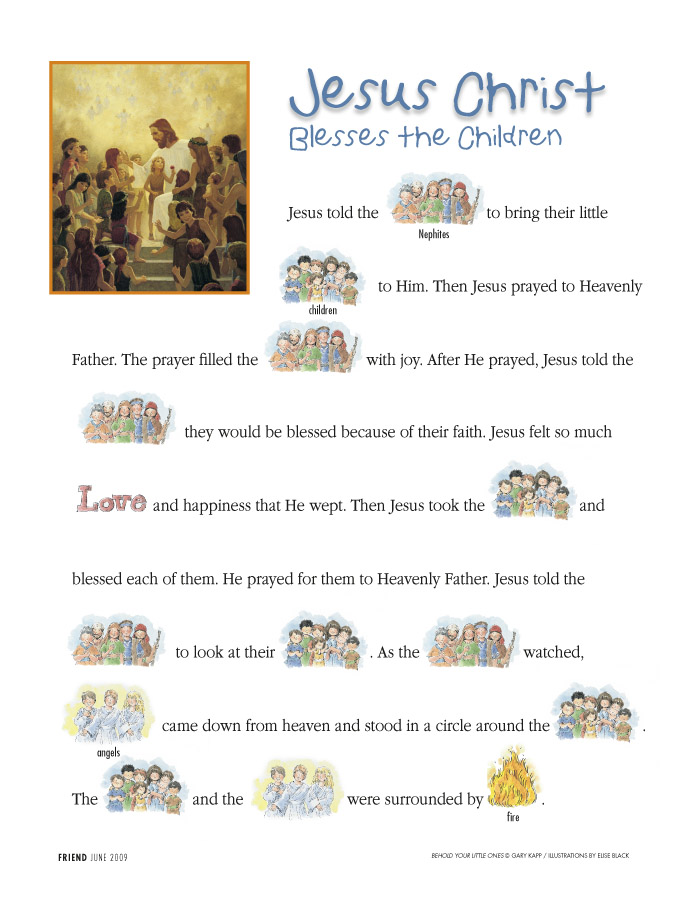
Family Night Idea: Read Rebus Story about Jesus Christ Blessing the Little Children. Sing Every Star is Different (Children’s Songbook, p. 142).
Sources
wikipedia.org: Pieter Bruegel the Elder, Great Artists Series- Bruegel, YouTube, freshlyplanted.com: Art Study: Pieter Bruegel, Part 2
Lesson Plan Resources

Record Resources
