
Art Lesson for The Family School

Peter Paul Rubens - Baroque Art
The children will learn that Peter Paul Rubens was a very intelligent and talented Baroque painter. They will recognize that we have been commanded to seek knowledge and learning.
Academic Concept: Peter Paul Rubens was a very intelligent and talented Baroque painter.
Gospel Principle: We have been commanded to seek knowledge and learning.
Home Preparation & Materials
Cut out (1) Freeze! Game Cards and place them in a bowl.
Digital Camera if available
Attention Activity
} Show the children the bowl of (1) Freeze Game Cards.
We are going to play a game called “Freeze!” To play this game we will need to work together to act out
the actions on these cards. One of you will choose a card and read it aloud. Then you will all act out
what it says on the card. The bigger your body movement, the better! Right in the middle of the action
I will call out, “Freeze!” When you hear the word “freeze” stop and freeze in whatever position you are in. Try to hold that position for five seconds while we examine the scene (and take a picture, if possible.) Let’s begin. } Do the activity. Repeat until all cards have been acted out or it is no longer fun. If you take photos, then examine the photo.
the actions on these cards. One of you will choose a card and read it aloud. Then you will all act out
what it says on the card. The bigger your body movement, the better! Right in the middle of the action
I will call out, “Freeze!” When you hear the word “freeze” stop and freeze in whatever position you are in. Try to hold that position for five seconds while we examine the scene (and take a picture, if possible.) Let’s begin. } Do the activity. Repeat until all cards have been acted out or it is no longer fun. If you take photos, then examine the photo.
You are trying to catch a mouse in your house.
You are dancing to crazy music.
You are catching balloons before they hit the ground.
You are popcorn popping out of the popper.
You are breaking a pinata and collecting candy.
You are winning a race, but trip over your shoelace.
You are tying up a ship in a windstorm.
You are digging for treasure in your backyard.
You are building a treehouse.
You are swatting at a swarm of mosquitos.
You are pulling someone from a pit.
You are starring in a ballet production.
Lesson
Today we are going to learn about an artist who loved to “freeze” the action and paint a dramatic scene.
His name is Peter Paul Rubens.
Freezing dramatic action was a popular artistic style of the Baroque period (1600–1750). In the
Baroque artistic style, artists used exaggerated motion and great detail to produce drama and
grandness.The artist we are learning about today, Peter Paul Rubens, was a master at doing this.
He was born in 1577. Just like Pieter Bruegel from our last lesson, Rubens was from the Flanders
(Dutch/Belgium) region of the Netherlands. In fact, Rubens became a teacher to Bruegel’s son, Jan
and helped him to become a great artist like his father. Here is a portrait Rubens did of Jan Brueghel
and his family.
} Show (2) Family of Jan Brueghel the Elder. Family was very important to Peter Paul Rubens. His first
wife died after 17 years of marriage and he remarried. He was a faithful father of eight children and
painted many portraits of members of his family.

Let’s look at a self portrait of Rubens and his first wife, Isabella. And then one of him and his son, Albert.
} Show (3) Self Portrait with Isabella Brandt (1609–1610) and (4) Rubens and Albert (1623–1700).
The idea of having more than one person in a portrait was a new idea in the 17th century and some
historians give Rubens credit for the new “family portrait” idea.


Perhaps family and being a good father were extra important to Rubens because of the trials he
had while he was growing up. When Peter was just a young boy his father was sent to prison for
his protestant beliefs. As a result his parents were separated, and he, along with his two siblings,
was raised by his Roman Catholic mother. His father passed away when he was only ten. His family
had very little money, so at age 13 Peter Paul and his brother went to work to help pay for his sister’s
wedding dowry. At first he worked as a page boy (which is like a messenger or delivery boy.) Later
he became apprenticed to an artist. This is when he found his passion for art. He was a hard worker
all of his life. Because of his great work ethic he became one of the most well-rounded and successful
artists of his time. (http://www.gardenofpraise.com/art46.htm)
When Peter Paul Rubens wanted to learn something he went right to work and worked hard to learn
all he could. One of his first jobs as an adult was following a famous artist around Europe and copying
his paintings. He practiced painting hundreds of paintings! As he observed and then copied he learned
the old styles of art. It was said that Rubens had a more vast knowledge of art history than any other
artist at that time. Rubens especially liked the Classical style. He often combined it with his own
Baroque style in unique ways. He painted glorified figures and mythological figures in realistic,
dramatic scenes.(http://www.artchive.com/artchive/R/rubens.html)
} Show (5) Saint George and the Dragon. This painting is called St. George and the Dragon. Notice
all the action.
#/media/File:Rubens_-_San_Jorge_y_el_Drag%C3%B3n_(Museo_del_Prado,_1605).jpg)
As he traveled throughout Europe his skill and fame were appreciated by many. He painted many
royal people. } Show (6) Deborah Kip and her Children. This a famous painting of a royal family
called Deborah Kip and her Children. Rubens was so exceptional at what he did that people said,
he was a “Prince of painters and a painter of princes.” He was even made a knight in England and Spain.
He is the only artist to be so honored at that time.

Rubens woke up every morning at 4:00 am to begin his work and studies. He became fluent
in five different languages. This made him very helpful to the royal people he painted for. As the
court artist he would hear and see things outsiders and politicians would not. He used his position
and talent for language to became a diplomat to help political leaders communicate with one another.
From his studies he became so learned in so many areas and subjects that he was called
“A Renaissance Man of the Baroque Period.”
Rubens was a devout Roman Catholic like his mother and made a small fortune painting for the church.
His religious scenes were intense with action and movement. Let’s look at one of his paintings that
was featured in the New Era magazine. } Show (7) Coup de lance, Christ’s Crucifixion.
You will have to scroll down a bit before you get to Rubens’ painting. It is a painting of the crucifixion
of Christ. As we look, notice the motion in the bodies and movement you feel from the painting.
It is almost as if no one is holding still.
Rubens did not shy away from doing big projects for the church or for political leaders. In fact,
he said “My talents are such that I have never lacked courage to undertake any design, however
vast in size or diversified in subject.” He designed floats, archways, parades, and projects that
included one hundred paintings for royal and religious events.
With the money he made from these big projects he created his own teaching studio in Antwerp,
Belgium where he trained other artists. He trained his apprentices by having them paint the first parts
of his paintings. Then he would add his details at the end to make the painting his own. In this way
he continued to design and create hundreds of paintings even as he grew old and had arthritis in his
hands. Peter Paul Rubens died in 1640 in Antwerp.
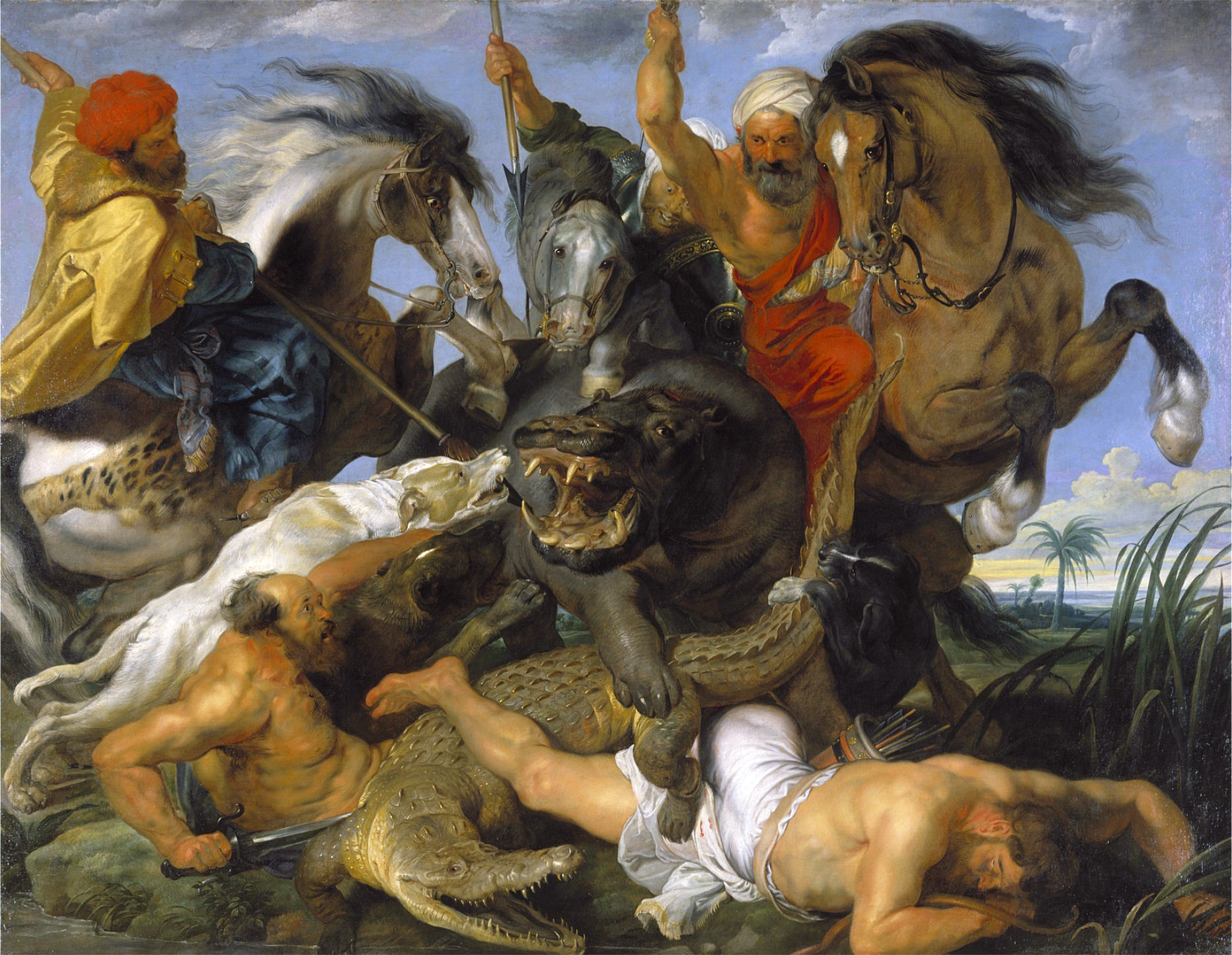
Let’s look at a good action scene painted by Rubens. } Show (8) Hippopotamus Crocodile Hunt.
This one has animals in it. He painted some very dramatic animal hunt scenes, including one of a
hippopotamus and crocodile hunt! Notice all of the movement in this painting.
} Show (9) Wolf and Fox Hunt (1615–1621). This is a painting called Wolf and Fox Hunt. Notice all
the action going on in the painting.

Doesn’t Rubens make a scene look so exciting and realistic! “Rubens was a very intelligent and
talented Baroque painter.” Write this academic concept on the board.
GOSPEL CONNECTION
As Rubens worked hard to improve his talents he never passed up an opportunity to learn something
new. In fact, he made time everyday to study and learn new things—and not just things about art.
Because he studied hard, he was able to help a lot of people as an artist, a father, and a diplomat.
In the church we learn that gaining knowledge is very important. In fact, gaining knowledge is a
God-like thing to do and it is a commandment. } Pass out (10) Education Quote by President Uchtdorf.
Let’s read what President Dieter F. Uchtdorf said in a 2009 General Conference:
For members of the church, education is not merely a good idea — it’s a commandment.
If formal education is not available, do not allow that to prevent you from acquiring all the
knowledge you can. ... The best books, in a sense, can become your ‘university’ — a classroom
that is always open and admits all who apply.
- What is it that can be “a classroom that is always open and admits all who apply?” (The best books.)
The Lord says in D&C 88:118:
And as all have not faith, seek ye diligently and teach one another words of wisdom; yea,
seek ye out of the best books words of wisdom; seek learning, even by study and also by faith.
- What do you think the Lord means by the “best books”? (Accept any answer.)
Joseph Smith taught: “We should gather all the good and true principles in the world and treasure
them up,” be they from Presbyterians, Baptists or anyone else, “or we shall not come out true
‘Mormons’” (Teachings of the Presidents of the Church: Joseph Smith)
“In other words, best books—books which lead us to God and draw our hearts out to others—need
not be explicitly ‘religious’ but can include fictional, scientific, philosophical, humorous and many other
elements.” (Learning to Seek Wisdom out of the Best Books)
- So what do we need to learn? What subjects does the Lord want us to study? (Accept any answer.)
Let’s read D&C 88:78–79 to see what the Lord says.
Teach ye diligently and my grace shall attend you, that you may be instructed more perfectly in
theory, in principle, in doctrine, in the law of the gospel, in all things that pertain unto the kingdom
of God, that are expedient for you to understand;
Of things both in heaven and in the earth, and under the earth; things which have been, things
which are, things which must shortly come to pass; things which are at home, things which
are abroad; the wars and the perplexities of the nations, and the judgments which are on the land;
and a knowledge also of countries and of kingdoms—
- That sounds like we should learn everything we can! Why do you think we need to learn all these things? (Accept any answer.)
The Lord tells us in verse 80.
That ye may be prepared in all things when I shall send you again to magnify the calling
whereunto I have called you, and the mission with which I have commissioned you.
- If we learn all we can, we will be better prepared to serve the Lord in any way He can use us. I want to be useful to the Lord. Do you? (Accept any answer.)
Today we have learned about Peter Paul Rubens, a great artist who worked hard and learned all
he could about many things. He is a great example to us. “We have been commanded to seek knowledge and learning.” Write this gospel principle on the board.
he could about many things. He is a great example to us. “We have been commanded to seek knowledge and learning.” Write this gospel principle on the board.
ART SUPPLIES
Littles: Art paper, crayon, marker
Middles/Bigs: Art paper, crayon, marker, paints or oil pastel, action photo of family
Littles Activity: Family Portrait Drawing
- Draw and color a picture of your family.
- When you finish, place your family portrait in the art section behind the My Art Projects divider.
Assignment: Write the names and birthdays of each family member in the family portrait drawing.
Middles/Bigs Activity: Family Freeze Sketch
- Use either one of the photos from the “Freeze Game” to copy, or another family action shot of your own, to design and draw your family in action.
- Pay special attention to the way bodies look when they are in motion.
- Sketch the bodies in motion.
- Add color using any medium you choose.
- When you finish coloring, place the artwork in the art notebook behind the My Art Projects divider.
Assignment: Brainstorm subjects that interest you and that you might want to learn more about. Write
these ideas down in a notebook. Choose one idea and begin studying this subject “just for fun”.
Assignment: Seek out a list of “best books” that you can read and learn from. (A good website to
search may be (12) A Thomas Jefferson Education) Then choose one to begin reading in your “spare”
time. Make a goal to read as many as you can in a specific period of time.
MORE FUN WITH PETER PAUL RUBENS
Art Extras: Have a member (or members) of your family pose while you sketch a family portrait.
Sources:
Lesson Plan Resources
(1) Freeze! Game Cards
Enrichment Resources
Web Gallery of Art http://www.tjed.org/resources/classics/
Out of the Best Books https://www.lds.org/new-era/1974/08/seek-ye-out-of-the-best-books?lang=eng