

Georges de la Tour - Light and Shadow
Children will learn about the simplified realism and use of light demonstrated by the painting of Georges de La Tour. Children will understand that by focusing on the Savior, the Light of the World, we can see what is most important.
Academic Concept:
Georges de La Tour was a French Reformation painter who simplified and strengthened his paintings by removing unimportant details and showing a strong light source.
Gospel Principle:
The Savior is the “Light of the World”. He can help us see what is most important if we focus on Him and His teachings.
Lesson Materials:
Flashlight, Candle or Lantern
Lesson Plan Resources:
Georges de La Tour, The Newborn, c. 1645-1648, Museum of Fine Arts of Rennes

Georges de La Tour, St. Joseph, the Carpenter, c.1645, Louvre Museum

Georges de La Tour, Adoration of the Shepherds, c. 1645, Louvre Museum

Georges de La Tour, Education of the Virgin, c. 1650, Frick Collection West Gallery

Georges de La Tour, The Cheat with the Ace of Clubs, c. 1630-1634, Kimbell Art Museum

Michelangelo Caravaggio, The Cardsharps, c. 1594, Kimbell Art Musuem

Artist Bio-
Georges de La Tour
1593-1692
French Reformation Painter
Georges de La Tour was the second of seven children born in Vic Sur-Seille, Lorraine.
He was a realistic painter like Caravaggio who used light and shadow. La Tour shined the light
brightest in his paintings on people’s faces and on things of religious significance, like scriptures
and on the Savior’s face. He put the details where the people were, not in the background and
throughout the entire painting like other Baroque realist painters did. He painted peaceful religious
scenes. The people in his paintings had simple, geometric faces that reflected the light more brightly.
He was a realistic painter like Caravaggio who used light and shadow. La Tour shined the light
brightest in his paintings on people’s faces and on things of religious significance, like scriptures
and on the Savior’s face. He put the details where the people were, not in the background and
throughout the entire painting like other Baroque realist painters did. He painted peaceful religious
scenes. The people in his paintings had simple, geometric faces that reflected the light more brightly.
He had ten children with his wife, Diane Le Nerf. One son, Etienne became a great artist as well.
La Tour was wealthy and famous during his lifetime and even painted for French royalty. He lost most
of his early work when a fire burned his city. He and his wife died in a flu epidemic in 1692. His artwork
lost its fame after his death, but he was rediscovered in the 20th century and is considered one of the
greats of his time.
La Tour was wealthy and famous during his lifetime and even painted for French royalty. He lost most
of his early work when a fire burned his city. He and his wife died in a flu epidemic in 1692. His artwork
lost its fame after his death, but he was rediscovered in the 20th century and is considered one of the
greats of his time.
New Vocabulary
Tenebroso- Italian for dark and gloomy
Chiaroscuro- (key-are-o-skoo-ro) Italian for light-dark, the use of strong contrasts between light and dark
Caravaggist- stylistic followers of the 16th-century Italian Baroque painter Caravaggio.
LESSON
Attention Activity
Gather all the children into a closet or other space that can be totally darkened.
While the lights are on I want you to describe everything that you can see. Now I am going to
turn on our flashlight and turn out the light.
turn on our flashlight and turn out the light.
Turn on the flashlight or lantern and turn out the lights. Hold the lantern in one place where
your faces can be seen.
your faces can be seen.
Now describe for me what you see now. Is the view a little different with the lights out?
Can you still see (name some things that they could see before with the lights on.)
Can you see my face? Can you see (name another face in the room)?
Can you still see (name some things that they could see before with the lights on.)
Can you see my face? Can you see (name another face in the room)?
If I had to say what was most important to me in this room I would say it is the things
that I can see right now. (Faces of family.)
that I can see right now. (Faces of family.)
Playing with light and dark is something artists love to do.
Today we will learn about an artist who used light in special ways to show the things that
were most important.
Today we will learn about an artist who used light in special ways to show the things that
were most important.
Lesson
Georges de la Tour was the second of seven children of a simple family of craftspeople.
His father was a master baker. He was born in 1593 in Lorraine (which is now part of France.)
In 1618 La Tour married the daughter of a duke, Diane Le Nerf and together they had at least
ten children. They lived and worked together happily until both he and his wife were killed in an
epidemic in 1652.
In 1618 La Tour married the daughter of a duke, Diane Le Nerf and together they had at least
ten children. They lived and worked together happily until both he and his wife were killed in an
epidemic in 1652.
Unlike some artists of his time he was a good businessman and become wealthy and famous
for his art while he was still alive. He painted for important French leaders, such as King Louis
XIII. He created a large workshop and had a lot of assistants and later taught some of his
children in his workshop, including his son Etienne who also became a great artist.
for his art while he was still alive. He painted for important French leaders, such as King Louis
XIII. He created a large workshop and had a lot of assistants and later taught some of his
children in his workshop, including his son Etienne who also became a great artist.
La Tour’s earliest works show that he was greatly influenced by Michaelangelo Caravaggio.
Do you remember Caravaggio from our last lesson? Because Caravaggio’s artistic style had
become so popular, La Tour probably didn’t have to go far from France to learn the techniques
from followers of the Italian master. Caravggio’s style was so famous people called this kind of
art “caravaggism” and those who followed Caravaggio’s style in France were called French
Caravaggists. La Tour become one of the most important of the French Caravaggists.
Do you remember Caravaggio from our last lesson? Because Caravaggio’s artistic style had
become so popular, La Tour probably didn’t have to go far from France to learn the techniques
from followers of the Italian master. Caravggio’s style was so famous people called this kind of
art “caravaggism” and those who followed Caravaggio’s style in France were called French
Caravaggists. La Tour become one of the most important of the French Caravaggists.
La Tour loved to use strong light and shadow and paint realistic everyday people like
Caravaggio and even painted some pictures of the same subjects as Caravaggio.
Caravaggio and even painted some pictures of the same subjects as Caravaggio.
} Show comparison of Caravaggio’s, The Cardsharps and Georges de La Tour’s Cheat with the Ace of Clubs. Georges de La Tour, The Cheat with the Ace of Clubs,
Look at these two paintings.
Can you see any similarities? (They are both playing cards, there is one hiding cards behind their back)
What is different?
Do you see any differences in the way these painters painted faces? (Caravaggio’s faces are more flat and simplistic.)
Unfortunately in Lorraine, where La Tour lived in the 1630’s, pestilence and war were
everywhere! And in 1638 his city went up in flames burning most of his early works in a fire.
Perhaps the fire was a turning point for La Tour, because the works following that time were
not so much genre paintings of everyday things or subjects copied from Caravaggio. His new
paintings showed a unique style and religious subjects. Unlike Caravaggio’s dramatic religious
paintings La Tour’s were peaceful and spiritual.
everywhere! And in 1638 his city went up in flames burning most of his early works in a fire.
Perhaps the fire was a turning point for La Tour, because the works following that time were
not so much genre paintings of everyday things or subjects copied from Caravaggio. His new
paintings showed a unique style and religious subjects. Unlike Caravaggio’s dramatic religious
paintings La Tour’s were peaceful and spiritual.
Georges de La Tour would place a candle in a dark room and dramatically light up his subjects.
The light would often be brightest on the Savior, on the scriptures, or faces of the people. He no
longer used a lot of detail in the foreground (front) of his paintings, or in the background. He
used simple shapes and dark shadows to give depth, but focus the details on the most
important parts of the painting- the people. The faces in his paintings were a little more flat,
angular and shape-like which eliminated shadows and made the light shine even brighter on
the faces.
The light would often be brightest on the Savior, on the scriptures, or faces of the people. He no
longer used a lot of detail in the foreground (front) of his paintings, or in the background. He
used simple shapes and dark shadows to give depth, but focus the details on the most
important parts of the painting- the people. The faces in his paintings were a little more flat,
angular and shape-like which eliminated shadows and made the light shine even brighter on
the faces.
Let’s take a look at The Newborn, by La Tour. Did you notice the simple shapes used
for the faces and how the light shined right on the baby? Now let’s examine some of La Tour’s
religious paintings from the life of Jesus Christ.
for the faces and how the light shined right on the baby? Now let’s examine some of La Tour’s
religious paintings from the life of Jesus Christ.
Here is a picture of the baby Jesus surrounded by the shepherds. Adoration of the Shepherds
Where does the light shine the brightest in this painting? (Baby Jesus, faces of the shepherds)
Where does the light shine the brightest in this painting? (Baby Jesus, faces of the shepherds)
Does this feel like a peaceful scene to you?
Now let’s look at two from Jesus’ childhood with his parents. Show St. Joseph, the Carpenter,
and Education of the Virgin. The first is of young Jesus with Joseph in his carpenter shop and
the second is Mary reading with Jesus. The name of the painting of Mary and Jesus is called
“Education of the Virgin”. Mary is sometimes called “the virgin”. Why do you think this painting
is named “Education of the Virgin” and not “Education of the Child”?
and Education of the Virgin. The first is of young Jesus with Joseph in his carpenter shop and
the second is Mary reading with Jesus. The name of the painting of Mary and Jesus is called
“Education of the Virgin”. Mary is sometimes called “the virgin”. Why do you think this painting
is named “Education of the Virgin” and not “Education of the Child”?
After examining these painting we can see that La Tour shined the light brightest in his paintings
on people’s faces and on the things of religious significance. He put the details where the people
were, not in the background and throughout the entire painting like other Baroque realist
painters did. He painted peaceful religious scenes with symbolic use of light.
on people’s faces and on the things of religious significance. He put the details where the people
were, not in the background and throughout the entire painting like other Baroque realist
painters did. He painted peaceful religious scenes with symbolic use of light.
As you see, Georges de La Tour was a French Reformation painter who simplified and
strengthened his paintings by removing unimportant details and showing a strong light source.
} Write this academic concept on the board.
strengthened his paintings by removing unimportant details and showing a strong light source.
} Write this academic concept on the board.
GOSPEL CONNECTION
In La Tour’s religious paintings of the Savior he used the most light on Jesus’ face. We
know from the scriptures that Jesus often compared Himself to light. In D&C 6:21
The Savior says, “I am the light which shineth in darkness”.
know from the scriptures that Jesus often compared Himself to light. In D&C 6:21
The Savior says, “I am the light which shineth in darkness”.
What do you think Jesus means when He says that He is “a light”?
Let’s read John 8:12 together. “Then spake Jesus again unto them, saying, I am the light
of the world: he that followeth me shall not walk in darkness, but shall have the light of life.”
of the world: he that followeth me shall not walk in darkness, but shall have the light of life.”
Do you like to walk in the dark? It is hard to find our way in the dark. Jesus says if we follow
Him we will never feel like we are walking in the dark. His example will guide us and show us
the way like a flashlight on a path.
Him we will never feel like we are walking in the dark. His example will guide us and show us
the way like a flashlight on a path.
In D&C 93:2 The Savior says, “I am the true light that lighteth every man that cometh
into the world”.
into the world”.
Remember when we were in the dark room at the beginning of the lesson, but with the flashlight
on we could see each other’s faces? The Savior is the light that can help us see people more
clearly.
on we could see each other’s faces? The Savior is the light that can help us see people more
clearly.
President Monson taught that caring for the people around us is one of the most important
ways to follow Christ. He said, “Never let a problem to be solved become more important than
a person to be loved.”
ways to follow Christ. He said, “Never let a problem to be solved become more important than
a person to be loved.”
What do you think this means? (People are more important than things.)
Relate
Let’s read what Brother Adrian Ochoa taught in the 2012 General Conference,
“We know that the Savior identified Himself as the Light of the World (seeJohn 9:5; 12:46). But in the Sermon on the Mount, He declared the same thing of His followers: “Ye are the light of the world. A city that is set on a hill cannot be hid. “Neither do men light a candle, and put it under a bushel, but on a candlestick; and it giveth light unto all that are in the house. “Let your light so shine before men, that they may see your good works, and glorify your Father which is in heaven” (Matthew 5:14–16).
The Savior is the light of the world, but who else can be a light? (His followers, us)
In 3 Nephi 18:24 it tells us exactly HOW we can be a light. Let’s read it together.
“Therefore, hold up your light that it may shine unto the world. Behold I am the lightwhich ye shall hold up—that which ye have seen me do.”
By doing what the Savior did, reaching out and caring for others, we can be a light too!
As you see, “The Savior is the “Light of the World”. He can help us see what is most
important if we focus on Him and His teachings.” } Write this gospel principle on the board.
important if we focus on Him and His teachings.” } Write this gospel principle on the board.
Review & Testimony
Let's review the academic concept and gospel principle we have learned today.
} As directed by the Spirit share your testimony of the gospel principle you have taught.
Using the Handwriting Practice Sheets or lined paper, record the academic concept and
the gospel principle you have learned today in your notebook.
} As directed by the Spirit share your testimony of the gospel principle you have taught.
Using the Handwriting Practice Sheets or lined paper, record the academic concept and
the gospel principle you have learned today in your notebook.
Academic Concept: Georges de La Tour was a French Reformation painter who simplified
and strengthened his paintings by removing unimportant details and showing a strong light
source.
and strengthened his paintings by removing unimportant details and showing a strong light
source.
Gospel Principle:
The Savior is the “Light of the World”. He can help us see what is most important if
we focus on Him and His teachings.
we focus on Him and His teachings.
ART PROJECTS
Supply List
Littles - Flashlight or lantern, large box, item for a still life, black paper, white chalk
Middles - Flashlight or Lantern, large box, item for a still life, colored paper, white chalk, dark chalk
Bigs - Candlestick and candle, items for a still life, paper, pencil, acrylic paint, paintbrushes
Littles: Tenebroso Chalk Art
- Choose a small simple still life item you would like to draw (ex. Apple, book, cup)
- Set your object in an open box turned on its side.
- Place a flashlight or lantern in the box with your object and turn on the light.
- Look at the way the light hits your object.
- Take a piece of black paper.
- Where the light shines brightest use your white chalk to draw your object on your black paper.
- You have created a tenebroso, light/dark picture!
Middles: Chiaroscuro Chalk Art
- Choose a small simple still life item you would like to draw (ex. Apple, book, cup)
- Set your object in an open box turned on its side.
- Place a flashlight or lantern in the box with your object and turn on the light.
- Look at the way the light hits your object.
- Take a piece of colored paper.
- Where the light shines brightest use your white chalk to draw your object on your colored paper.
- Where the shadows are darkest use your dark chalk to shade your object. Press the hardest with your chalk where it is darkest. Shade more lightly as the dark gets lighter.
- Where your object is not very light or very dark, but in the middle, leave it the color of your paper.
- You have created a chiaroscuro, light/dark picture!
- Writing Assignment: Write in your journal about how Christ’s light can help you be a light to others.
Bigs: Paint Your Own Chiaroscuro
- Invite your high school student to learn more about the art of chiaroscuro
- painting by doing some research at the local library or on the Internet.
- Offer your child a piece of paper and a pencil so he can take notes on
- chiaroscuro painting and painters. Encourage him to make a list of his favorite artists and paintings that he discovers.
- Chiaroscuro paintings are often focused on a portrait or action, but your child
- can create a dramatic still life instead. Encourage your child to gather items and arrange them in an intriguing way. He can also find a candlestick as well as acandle to use while painting.
- Encourage your child to create a sketch before beginning to paint.
- Remind him to think about areas of light and dark within the painting.
- To create a true chiaroscuro painting, your child can work in a room that can be darkened so that the candle really is the only illumination of his still life!
- Now he can begin painting, working slowly and thinking about color gradations.
- He can use an extra sheet of scrap paper as a palette for mixing colors to create shades and hues.
- Consider showing your candle in the picture like Georges de la Tour.
- Once his chiaroscuro painting is finished, place the painting in a gilded frame for others to see.(http://www.education.com/activity/article/chiaroscuro-painting/)
- Assignment: Make a list of the things that are most important to you. Write in your journal how having Christ’s light can help you focus on the things that are most important.
EXTRA Fun with Georges de La Tour
Video teaching more about the history Chiaroscuro (watch until 1:10)
Video teaching how chiaroscuro is still used today (to 2:48)
Family Night Idea: Use this lesson https://www.lds.org/friend/2003/10/sharing-time-the-light-of-christ?lang=eng, and
learn the words to this song https://www.lds.org/music/library/hymns/the-lord-is-my-light?lang=eng
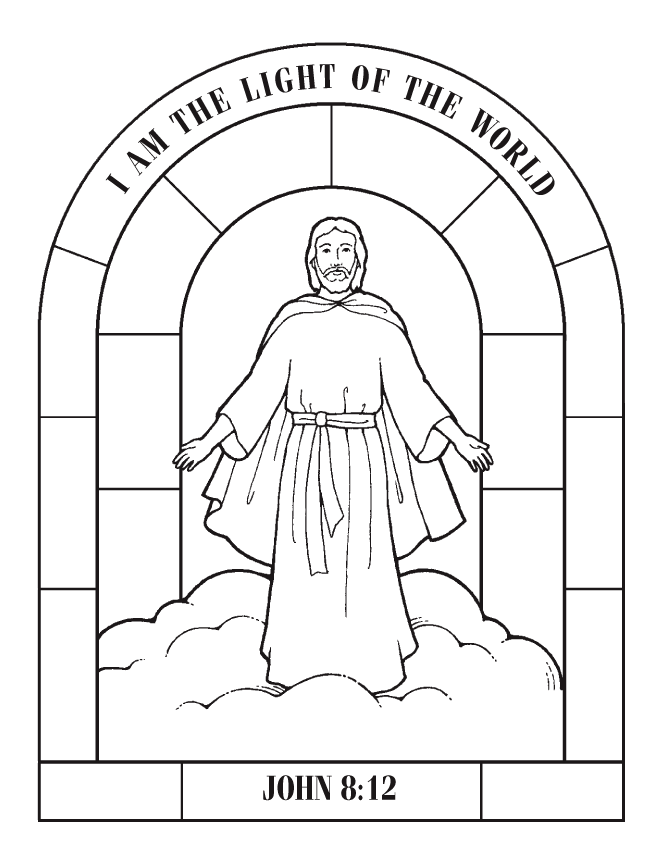
Coloring Page: https://www.lds.org/bc/content/shared/content/images/gospel-library/magazine/friendlp.nfo:o:b40.jpgFamily Night Idea: Use this lesson https://www.lds.org/friend/2003/10/sharing-time-the-light-of-christ?lang=eng, and
learn the words to this song https://www.lds.org/music/library/hymns/the-lord-is-my-light?lang=eng
Research Sources:
http://www.visual-arts-cork.com/old-masters/georges-la-tour.htm